Overview
Have you completed the EcoTypes survey? Would you like to be better prepared to talk with people who disagree with you on environmental issues? This activity may help. You’ll put your survey entry key in the box at the bottom of this page, then click the button and you’ll immediately receive customized instructions.
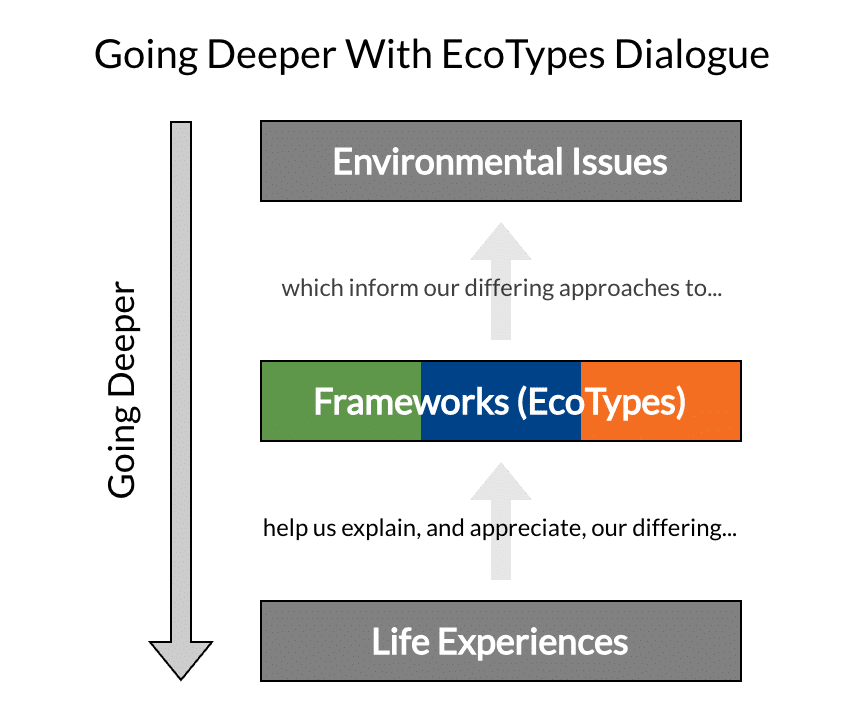
This is how it works: you will train an AI agent* to play the role of your complementary (opposing) EcoType, then engage in a text-based dialogue on an environmental issue of your choice, exploring how your differing EcoTypes frameworks may affect your approach to the issue, and considering how your varied life experiences may help explain your differing EcoTypes! From there, you may be able to return to the issue and consider inclusive solutions that build on these diverse life experiences and related EcoTypes frameworks.
By going deeper, you may experience a more satisfying conversation, even if you ultimately do not agree on a solution to your environmental issue. This role-play dialogue will be less stressful than an actual conversation, but you will experience what it feels like to engage in the back-and-forth of dialogue across difference, so you can gain skills transferable to a real-world opportunity—where going deeper may yield surprisingly satisfying results.
As the EcoTypes home page says: “We disagree. That’s good! Our differing EcoTypes can be a source of creative solutions.” Ready to give it a try?
Give it a try!
Would you like to stretch yourself and try out this EcoTypes dialogue with a role-play AI agent? Just provide your EcoTypes survey entry key below and click the button. You’ll then receive customized instructions. If you ever lose these instructions, come back to this page and repeat.
We would love to hear how your dialogue across difference goes! Feel free to complete the question form, making sure to specify the AI platform you used.
*Concerned about using AI? We understand! This activity is your choice. Make sure to ground your concerns in recent scholarship on the wide range of possible risks and benefits of AI. Two example publications (Alzoubi and Mishra 2024; Capraro et al. 2024) are listed and linked below.
- Alzoubi, Yehia Ibrahim, and Alok Mishra. 2024. “Green Artificial Intelligence Initiatives: Potentials and Challenges.” Journal of Cleaner Production 468 (August): 143090.
- Capraro, Valerio, Austin Lentsch, Daron Acemoglu, et al. 2024. “The Impact of Generative Artificial Intelligence on Socioeconomic Inequalities and Policy Making.” PNAS Nexus 3 (6): pgae191.