Overview | PL/KN | KN/AC | AC/PL | KN SUBTypes
Overview
What is your EcoType?
Your EcoType is your broad approach to environmental issues. You can discover your EcoType by completing the survey. Different people approach environmental issues differently, but our differing EcoTypes can be a source of creative solutions—provided we more systematically understand, and learn better ways to communicate across, our differences. This is the intent of EcoTypes!
There are twelve EcoTypes: four for each of the three domains below. Building on thousands of survey responses, we have statistically identified three main themes underlying our differences: Place, Knowledge, and Action.
Each domain below, and your EcoType, are based on the two most important themes suggested in your survey responses.


EcoTypes based on survey scores for Place/Knowledge (left), Knowledge/Action (middle), and Action/Place (right) theme domains. (–) scores point to the left and bottom of each domain, and (+) scores point to the right and top. There are no right nor wrong scores! Click any EcoTypes domain to expand.
EcoTypes are, in effect, our differing answers to the key theme questions:
- (Place) What is the place of nonhumans and humans on Earth?
- (Knowledge) What old and new ways of knowing will help us build this place?
- (Action) What action at small and big scales will help us build this place?
These are big questions! And there are many ways people answer them. That’s why there are many different EcoTypes.
EcoTypes around the world
What are the EcoTypes of people around the world? The EcoTypes survey has not yet covered all parts of the world and all ages, so we cannot offer an answer based on EcoTypes alone. But EcoTypes is guided in part by major cross-national studies of values, including the World Values Survey and the Schwartz values research program.
These studies suggest fundamental dimensions of values, just like EcoTypes suggests Place, Knowledge, and Action as three main themes of difference. The example below, from the World Values Survey, plots countries of the world based on survival vs. self-expression values, and traditional vs. secular values.
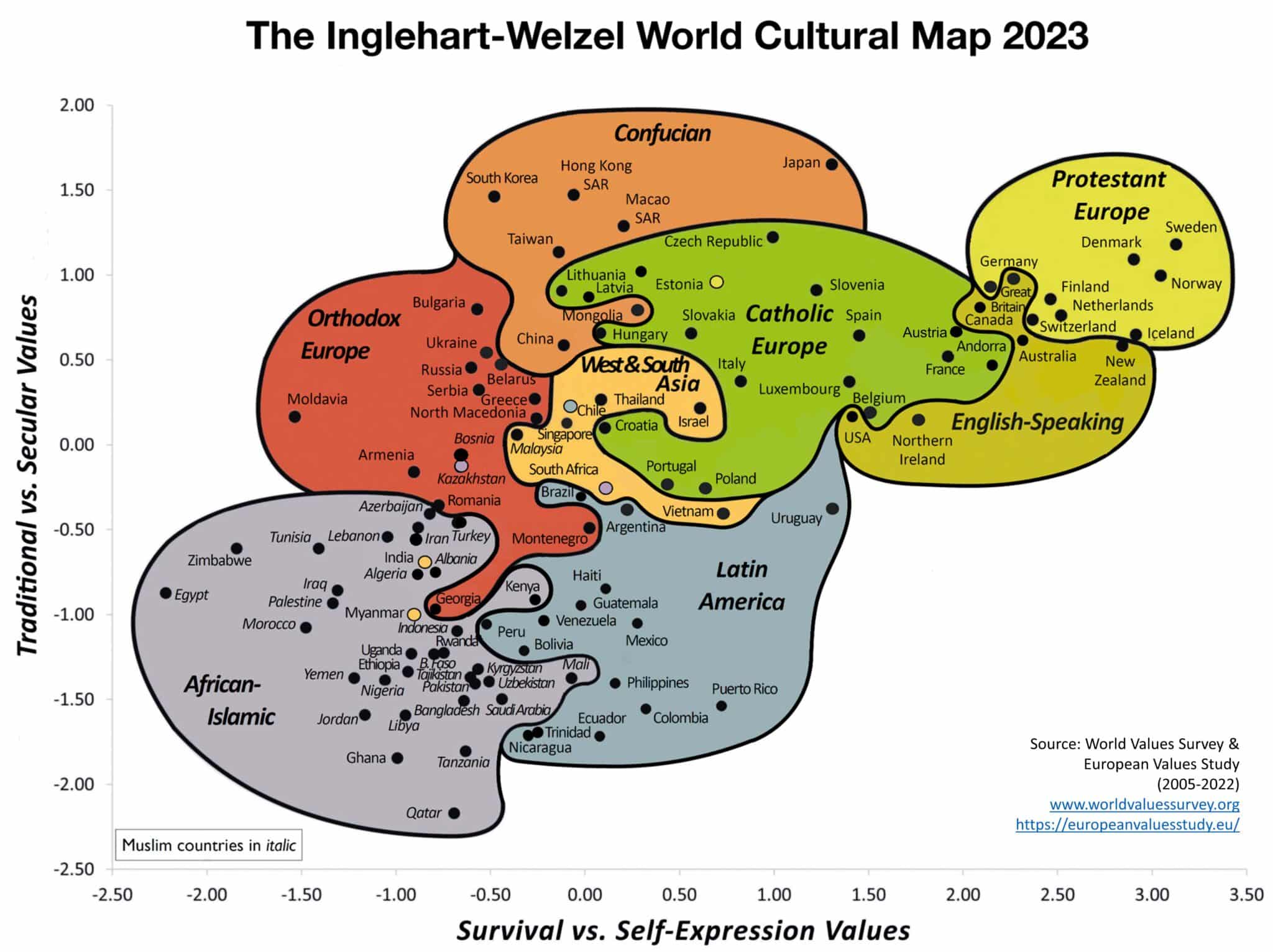
Below you can read more on the four EcoTypes for each of the three theme domains. Each also includes an idealized persona exemplifying their EcoType, including a global priority (Sustainable Development Goal) they support to suggest one policy application.
Place/Knowledge EcoTypes
Earth Spirit | Ecoscience | Traditional Ways | Technoprogress
There are four Place/Knowledge EcoTypes; a theme comparison is below, followed by details on each.
| EcoType | Place | Knowledge |
|---|---|---|
| Earth Spirit | Nonhuman | Old |
| Ecoscience | Nonhuman | New |
| Traditional Ways | Human | Old |
| Technoprogress | Human | New |
There is nothing inherently good or bad in any of these EcoTypes; they are just differing ways of approaching the key Place and Knowledge questions at top.
Earth Spirit
Earth Spirit primarily embraces nonhuman Place and old Knowledge; this EcoType is thus in the lower left sector below. Its complementary EcoType is Technoprogress.

Nonhuman Place and old Knowledge are theme attractors, each summarizing four related EcoTypes axis poles. Feel free to study these poles via the links below. If your EcoType is Earth Action, which make sense to you?
| Nonhuman Place | Old Knowledge |
|---|---|
| Wild Aesthetics | Heterodox Science |
| Stable Ecosystems | Sacred Spirituality |
| Biocentric Ethics | Phobic Technology |
| Pure Nature | Past Time |
Below is Sage, the EcoTypes persona representing Earth Spirit. Like the theme attractors and axis poles above, this persona is simply an idealized representation, but Sage and other personae may help you better understand the twelve differing EcoTypes.

Sage (Earth Spirit): Sage grew up in the city, but loves to wander in the forest as her way of connecting with the spiritual force. She makes careful lifestyle choices, only buying products that are labeled sustainable or natural. One SDG she prioritizes is Responsible Consumption and Production.
Ecoscience
Ecoscience primarily embraces nonhuman Place and new Knowledge; this EcoType is thus in the upper left sector below. Its complementary EcoType is Traditional Ways.

Nonhuman Place and new Knowledge are theme attractors, each summarizing four related EcoTypes axis poles. Feel free to study these poles via the links below. If your EcoType is Ecoscience, which make sense to you?
| Nonhuman Place | New Knowledge |
|---|---|
| Wild Aesthetics | Orthodox Science |
| Stable Ecosystems | Secular Spirituality |
| Biocentric Ethics | Philic Technology |
| Pure Nature | Future Time |
Below is Latisha, the EcoTypes persona representing Earth Spirit. Like the theme attractors and axis poles above, this persona is simply an idealized representation, but Latisha and other personae may help you better understand the twelve differing EcoTypes.

Latisha (Ecoscience): Latisha has thrived as a person of color in science, and grew up spending frequent times with her family outdoors, so she plans to do field research in ecology. On SDG she prioritizes is Life On Land, to contribute her work toward terrestrial biodiversity conservation.
Traditional Ways
Traditional Ways primarily embrace human Place and old Knowledge; this EcoType is thus in the lower right sector below. Its complementary EcoType is Ecoscience.

Human Place and old Knowledge are theme attractors, each summarizing four related EcoTypes axis poles. Feel free to study these poles via the links below. If your EcoType is Traditional Ways, which make sense to you?
| Human Place | Old Knowledge |
|---|---|
| Crafted Aesthetics | Heterodox Science |
| Dynamic Ecosystems | Sacred Spirituality |
| Anthropocentric Ethics | Phobic Technology |
| Hybrid Nature | Past Time |
Below is Mustafa, the EcoTypes persona representing Traditional Ways. Like the theme attractors and axis poles above, this persona is simply an idealized representation, but Mustafa and other personae may help you better understand the twelve differing EcoTypes.

Mustafa (Traditional Ways): Mustafa is a student from Turkey planning on a career in business and marketing. His family is devout Muslim, and his faith is an important part of his life, guiding him to serve humanity. One SDG he prioritizes as a businessperson is Decent Work and Economic Growth.
Technoprogress
Technoprogress primarily embraces human Place and new Knowledge; this EcoType is thus in the upper right sector below. Its complementary EcoType is Earth Spirit.

Human Place and new Knowledge are theme attractors, each summarizing four related EcoTypes axis poles. Feel free to study these poles via the links below. If your EcoType is Technoprogress, which make sense to you?
| Human Place | New Knowledge |
|---|---|
| Crafted Aesthetics | Orthodox Science |
| Dynamic Ecosystems | Secular Spirituality |
| Anthropocentric Ethics | Philic Technology |
| Hybrid Nature | Future Time |
Below is Aisha, the EcoTypes persona representing Traditional Ways. Like the theme attractors and axis poles above, this persona is simply an idealized representation, but Aisha and other personae may help you better understand the twelve differing EcoTypes.

Aisha (Technoprogress): Aisha studies engineering, and hopes to develop energy-efficient solar panels for rural people without electricity, in order to help improve their lives. One SDG she prioritizes is Industry, Innovation and Infrastructure, to which she can lend her engineering expertise.
Knowledge/Action EcoTypes
Personal Wisdom | Radical Spirituality | Incremental Progress | Science for Change
There are four Knowledge/Action EcoTypes; a theme comparison is below, followed by details on each.
| EcoType | Knowledge | Action |
|---|---|---|
| Personal Wisdom | Old | Small |
| Radical Spirituality | Old | Big |
| Incremental Progress | New | Small |
| Science for Change | New | Big |
There is nothing inherently good or bad in any of these EcoTypes; they are just differing ways of approaching the key Knowledge and Action questions at top.
Personal Wisdom
Personal Wisdom primarily embraces old Knowledge and small Action; this EcoType is thus in the lower left sector below. Its complementary EcoType is Science for Change.

Old Knowledge and small Action are theme attractors, each summarizing four related EcoTypes axis poles. Feel free to study these poles via the links below. If your EcoType is Personal Wisdom, which make sense to you?
| Old Knowledge | Small Action |
|---|---|
| Heterodox Science | Incremental Change |
| Sacred Spirituality | Market Economies |
| Phobic Technology | Individual Social Scale |
| Past Time | Consensus Society |
Below is Joaquin, the EcoTypes persona representing Personal Wisdom. Like the theme attractors and axis poles above, this persona is simply an idealized representation, but Joaquin and other personae may help you better understand the twelve differing EcoTypes.

Joaquin (Personal Wisdom): Joaquin grew up with Western medicine, but routinely practices meditation, with personal insights in line with traditional approaches to healing. Joaquin plans to become a holistic health practitioner for others to benefit. One SDG they prioritize is Good Health & Well-Being.
Radical Spirituality
Radical Spirituality primarily embraces old Knowledge and big Action; this EcoType is thus in the upper left sector below. Its complementary EcoType is Incremental Progress.

Old Knowledge and big Action are theme attractors, each summarizing four related EcoTypes axis poles. Feel free to study these poles via the links below. If your EcoType is Radical Spirituality, which make sense to you?
| Old Knowledge | Big Action |
|---|---|
| Heterodox Science | Radical Change |
| Sacred Spirituality | Planned Economies |
| Phobic Technology | Institutional Social Scale |
| Past Time | Conflict Society |
Below is River, the EcoTypes persona representing Personal Wisdom. Like the theme attractors and axis poles above, this persona is simply an idealized representation, but River and other personae may help you better understand the twelve differing EcoTypes.

River (Radical Spirituality): River identifies as nonbinary, participating in Wiccan and other forms of Earth spirituality that celebrate gender diversity. River draws upon this inspiration as a gender activist, advocating for systemic overthrow of patriarchy; one SDG they support is Gender Equality.
Incremental Progress
Incremental Progress primarily embraces new Knowledge and small Action; this EcoType is thus in the lower right sector below. Its complementary EcoType is Radical Spirituality.

New Knowledge and small Action are theme attractors, each summarizing four related EcoTypes axis poles. Feel free to study these poles via the links below. If your EcoType is Incremental Progress, which make sense to you?
| New Knowledge | Small Action |
|---|---|
| Orthodox Science | Incremental Change |
| Secular Spirituality | Market Economies |
| Philic Technology | Individual Social Scale |
| Future Time | Consensus Society |
Below is Kabir, the EcoTypes persona representing Personal Wisdom. Like the theme attractors and axis poles above, this persona is simply an idealized representation, but Kabir and other personae may help you better understand the twelve differing EcoTypes.

Kabir (Incremental Progress): Kabir envisions a future world of appropriate technologies that improve environmental and human conditions. He plans to contribute via research to develop small-scale energy generation for remote communities. One SDG he prioritizes is Affordable and Clean Energy.
Science for Change
Science for Change primarily embraces new Knowledge and big Action; this EcoType is thus in the upper right sector below. Its complementary EcoType is Personal Wisdom.

New Knowledge and big Action are theme attractors, each summarizing four related EcoTypes axis poles. Feel free to study these poles via the links below. If your EcoType is Science for Change, which make sense to you?
| New Knowledge | Big Action |
|---|---|
| Orthodox Science | Radical Change |
| Secular Spirituality | Planned Economies |
| Philic Technology | Institutional Social Scale |
| Future Time | Conflict Society |
Below is Nathan, the EcoTypes persona representing Personal Wisdom. Like the theme attractors and axis poles above, this persona is simply an idealized representation, but Nathan and other personae may help you better understand the twelve differing EcoTypes.

Nathan (Science for Change): Nathan is studying oceanography, with an associated interest in international environmental policy. He looks forward to promoting science-based policy and internationally binding regulations. One SDG he thus prioritizes is Peace, Justice and Strong Institutions.
Knowledge Subtypes
In addition to your EcoType, the report you receive from the EcoTypes survey also includes your Knowledge subtype; what does this mean? The Knowledge theme has two attractors, old and new Knowledge, with related axis poles as summarized below; old and New Knowledge are two of the three Knowledge subtypes.
| Old Knowledge | New Knowledge |
|---|---|
| Heterodox Science | Orthodox Science |
| Sacred Spirituality | Secular Spirituality |
| Phobic Technology | Philic Technology |
| Past Time | Future Time |
Yet analysis of thousands of survey responses suggests a third Knowledge subtype. Some responses indeed embraced old or new Knowledge, as defined by their axis poles above; yet others seemed to embrace a different approach. Overall, looking at thousands of axis responses, there are two statistical clusters:

As the diagram suggests, all four are correlated and thus part of the common Knowledge theme, but Spirituality and Time, and Science and Technology, are more closely correlated. And many respondents tend toward old Knowledge (–) on Spirituality and Time, but toward new Knowledge (+) on Science and Technology.
We call this pattern integral, vs. old or new, Knowledge, following the integral ecology philosophy in which religion and science—old and new Knowledge—offer convergent environmental guidance. The three Knowledge subtypes resonate with longstanding discussions and debates over the role of religion and spirituality (old) vs. science (new) in providing guidance to our lives.
As noted with EcoTypes above, none of these three Knowledge subtypes are inherently better or worse!; they are just different ways of addressing the big Knowledge theme question at the top of this page.
Action/Place EcoTypes
Small Green Steps | Earth Action | Resource Stewardship | Social Justice
There are four Action/Place EcoTypes; a theme comparison is below, followed by details on each.
| EcoType | Action | Place |
|---|---|---|
| Small Green Steps | Small | Nonhuman |
| Resource Stewardship | Small | Human |
| Earth Action | Big | Nonhuman |
| Social Justice | Big | Human |
There is nothing inherently good or bad in any of these EcoTypes; they are just differing ways of approaching the key Action and Place questions at top.
Small Green Steps
Small Green Steps primarily embraces small Action and nonhuman Place; this EcoType is thus in the lower left sector below. Its complementary EcoType is Social Justice .

Small Action and nonhuman Place are theme attractors, each summarizing four related EcoTypes axis poles. Feel free to study these poles via the links below. If your EcoType is Small Green Steps, which make sense to you?
| Small Action | Nonhuman Place |
|---|---|
| Incremental Change | Wild Aesthetics |
| Market Economies | Stable Ecosystems |
| Individual Social Scale | Biocentric Ethics |
| Consensus Society | Pure Nature |
Below is Claire, the EcoTypes persona representing Small Green Steps. Like the theme attractors and axis poles above, this persona is simply an idealized representation, but Claire and other personae may help you better understand the twelve differing EcoTypes.

Claire (Small Green Steps): Claire believes that the best environmental action is at local, neighborhood scales. Claire volunteers at a nearby community garden, and works to recruit others to grow their own organic produce there. One SDG Claire supports is Sustainable Cities and Communities.
Resource Stewardship
Resource Stewardship primarily embraces small Action and human Place; this EcoType is thus in the upper left sector below. Its complementary EcoType is Earth Action.

Small Action and human Place are theme attractors, each summarizing four related EcoTypes axis poles. Feel free to study these poles via the links below. If your EcoType is Resource Stewardship, which make sense to you?
| Small Action | Human Place |
|---|---|
| Incremental Change | Crafted Aesthetics |
| Market Economies | Dynamic Ecosystems |
| Individual Social Scale | Anthropocentric Ethics |
| Consensus Society | Hybrid Nature |
Below is Isaiah, the EcoTypes persona representing Resource Stewardship. Like the theme attractors and axis poles above, this persona is simply an idealized representation, but Isaiah and other personae may help you better understand the twelve differing EcoTypes.

Isaiah (Resource Stewardship): Isaiah is planning on a career in agriculture with his family farm. He hopes to help alleviate hunger via wise management of his cropland resource, distributing produce at reduced cost to needy families in the community. One SDG he prioritizes is Zero Hunger.
Earth Action
Earth Action primarily embraces big Action and nonhuman Place; this EcoType is thus in the lower right sector below. Its complementary EcoType is Resource Stewardship.

Big Action and nonhuman Place are theme attractors, each summarizing four related EcoTypes axis poles. Feel free to study these poles via the links below. If your EcoType is Earth Action, which make sense to you?
| Big Action | Nonhuman Place |
|---|---|
| Radical Change | Wild Aesthetics |
| Planned Economies | Stable Ecosystems |
| Institutional Social Scale | Biocentric Ethics |
| Conflict Society | Pure Nature |
Below is Morgan, the EcoTypes persona representing Earth Action. Like the theme attractors and axis poles above, this persona is simply an idealized representation, but Morgan and other personae may help you better understand the twelve differing EcoTypes.

Morgan (Earth Action): Morgan is a committed environmental activist, joining up with friends to protest greedy corporations that ruin nature. One SDG Morgan prioritizes is Climate Action, seeking to heal the planet from capitalist fossil fuel destruction and move toward more Earth-friendly energy production.
Social Justice
Social Justice primarily embraces big Action and human Place; this EcoType is thus in the upper right sector below. Its complementary EcoType is Small Green Steps.

Big Action and human Place are theme attractors, each summarizing four related EcoTypes axis poles. Feel free to study these poles via the links below. If your EcoType is Social Justice, which make sense to you?
| Big Action | Human Place |
|---|---|
| Radical Change | Crafted Aesthetics |
| Planned Economies | Dynamic Ecosystems |
| Institutional Social Scale | Anthropocentric Ethics |
| Conflict Society | Hybrid Nature |
Below is Isabella, the EcoTypes persona representing Social Justice. Like the theme attractors and axis poles above, this persona is simply an idealized representation, but Isabella and other personae may help you better understand the twelve differing EcoTypes.

Isabella (Social Justice): Isabella advocates structural change in our global political system to halt continued injustices faced by marginalized peoples of the Global South. One SDG she prioritizes is Reduced Inequalities, to achieve greater equity among all people of the world.